
You turn the key and the engine spins: ra-ra-ra, over and over, but it never catches. That sound is frustrating, but it is also information. When the crank sounds healthy and normal-speed, the battery and starter are usually doing their jobs, and the problem is typically somewhere else: fuel, spark, or the timing that brings them together. Here is how to think about it, the checks worth doing yourself, and when to stop cranking.
First, make sure it really is cranking normally
Cranking means the engine physically turns over. Listen to how it sounds before anything else:
- Slow or laboured cranking still points at the battery or starter. A weak battery can turn the engine over but too slowly to start it, so a crank that sounds tired belongs in the clicking-and-weak-crank guide, not this one.
- Rapid clicking or a single click is the no-crank family, usually battery, terminals or starter, also covered there. A safe jump-start, when the battery is the whole problem, is covered in our jump-start guide.
- The key will not turn at all is often the steering lock: easing the wheel left and right while turning the key usually frees it.
- Nothing happens in Park? Most automatics only crank in Park or Neutral; trying Neutral with the parking brake set is a fair check, and AAA notes a faulty neutral safety switch can block cranking entirely. Same for push-button cars that stop recognizing a dying key fob: the owner's manual has the backup method, and our fob battery guide has the warning signs.
A healthy, normal-speed spin with no start is what the rest of this guide is about.
The one simple check that fits: fuel
It sounds obvious, but AAA lists low fuel among the common no-start causes, and gauges and range estimates can be wrong. If there is any doubt about what is actually in the tank, ruling that out costs nothing and needs no tools.
If the fuel check is not it: fuel delivery or spark
An engine needs fuel, spark and compression, in the right amounts at the right time. When cranking is normal, the usual suspects are:
- Fuel delivery. A failed fuel pump, a clogged fuel filter, or a bad fuel pump relay can starve the engine. AAA notes fuel problems often show warning signs first: sluggish acceleration, erratic running, worse fuel economy. Many cars hum for a second or two from the tank area when you turn the key to ON; silence there is a clue a mechanic will check.
- Spark. Worn or fouled spark plugs can prevent a start. AAA's warning signs: misfires or sputtering, rough idle, sluggish acceleration, a check engine light, or a fuel smell from unburned fuel.
- Fuses and relays. A single blown fuse or failed relay in the fuel or ignition circuit can stop an otherwise healthy car.
Beyond listening and the fuel check, this is diagnosis territory, not parts-swapping. Which system has failed is something a mechanic confirms with tests, because the same symptom has several causes and the wrong guess costs real money.
One cause where you should stop cranking
AAA's list includes the timing belt, the part that keeps the top and bottom of the engine in sync. Not every engine has one: many use a timing chain instead, and your owner's manual or service records say which your car has and when the belt is due if it has one. If a belt fails, the engine can crank without ever starting, and on many engines a broken belt means internal damage. If your cranking suddenly sounds different from usual, or the car has high kilometres and no record of a belt change, stop trying and get it checked. Repeated cranking will not fix a mechanical failure and can add to the repair.
Why not to just keep cranking
Owner's manuals generally call for short cranks of a few seconds with pauses between, not one long hold: the starter motor is built for brief work and can overheat. And each failed attempt pumps a little unburned fuel through the engine. Two or three honest attempts, then switch from cranking to diagnosing.
What that means in the Lower Mainland
A crank-no-start here usually happens at the worst address: an underground parkade, a sloped driveway, a tight street pad. The good news is this is exactly the kind of job that comes to you. Fuel, spark and sensor checks do not need a shop lift, and neither do most of the fixes.
What a visit looks like
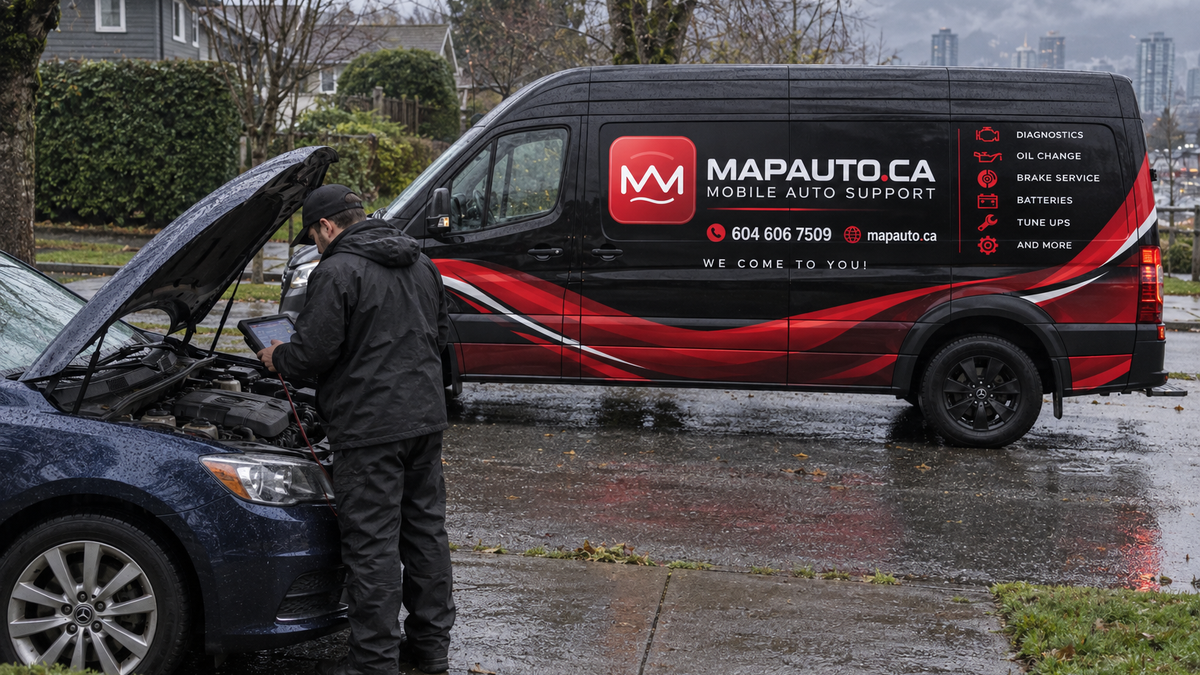
Call (604) 606-7509 and describe the sound. We come to you, listen to the crank, check for fuel and spark with proper tools, and scan the car for stored codes. You get a straight answer on which system failed and what the fix costs before any parts go on.
Common questions
If it cranks, the battery is fine?
Not automatically. If the crank is slow or laboured, the battery or starter is still a live suspect: a tired battery can turn the engine too slowly to start it. What a strong, normal-speed crank tells you is that the battery and starter are usually not the problem, which points toward fuel, spark or timing. A test is still the only certain answer.
Can I keep trying until it starts?
Better not. Manuals generally specify short cranks with pauses, because starters overheat. And if the cause is mechanical, like a failed timing belt, more cranking can make the damage worse. Two or three attempts, then diagnose.
It started eventually last week. Should I still get it looked at?
Yes. Intermittent no-starts tend to become permanent ones, and the warning signs AAA lists, rough running, sluggish acceleration, a check engine light, are the car filing its complaint early. Catching a weak fuel pump or worn plugs at this stage is almost always simpler than the tow-truck version.
Related services
Call (604) 606-7509 and tell us what it sounds like. We come to you across the Lower Mainland, 7am to 7pm every day.